Tone Indicators
Note: You do not need to remember all the tone sounds. You only need to understand how to use the tone indicators. The tone sound pages are for your reference only. However, there are some who find that memorize all the sounds become very helpful.
The tones may seem pretty tough to understand at first, but as you use the tones sounds page and start listening to the difference each tone makes. It will become easier and easier to understand.
Tone indicators are always positioned at the end of a word and it determines the tone or pitch of the word. In the Hmong language, the tone of the word is very important. Changing the tone of a word just a tiny bit can completely alter it's meaning.
For example in the english language, when you say the word while in a very excited manor. Then you say the word like you are asking a question. The word still has the same definition. But in the Hmong language the pitch is different so they would be two completely different words.
Below is an example of three hmong words with the definition. The words start with the same consonant and vowel, but has a different tone indicator. Which changes the tone or pitch of the word, thus becoming completely different words with different meaning.
- dress
- real or support
- flat
There are 8 tone indicators in the Hmong language. Each one basically changes the tone of each vowel within a word. Note if a word does not have a letter indicator (j, g, v, s, m, b, d) it is known as the neutral tone.
Tone Levels
Below is an example graph of the tone levels.
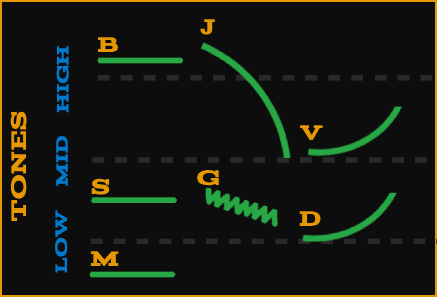
To Help you better understand the tones I am going to use the vowel with the apporiate pitch.
J - Very High down to mid
B - High Tone
blank - Middle Tone
S - Low-mid Tone
M - Lowest Tone
V - Mid Raising
G - Mid-Low to low nauseated/Breathy
D - Low Raising
Here are some tips to help you remember the tone indicators
B is your basic high tone
no indicator is your basic middile tone
S is your low tone
The tone is the highest tone indicator and is similair to when you say things in a very excited manor, almost like your yelling. Example is the word (Note the exclamation point). This word is normally spoken in a high tone. In Hmong any word with the tone indicator is spoken in a very high tone.
Let's take the letter and use it in an example. When you add the tone indicator it becoomes and is spoken in a high tone. (Go to the tone sounds page to see more examples).
When you see the tone indictor use a high tone.
The is a raising tone indicator. Meaning that the V starts at the mid tone, raises up and ends at the high tone. For example . One tip to help remember this indicator is to think of the way you ask questions. Think of the sound of the last word in your question. For example when you say the word , listening to just the sounds, you can tell that it starts at the mid tone and raises up.
Here are some examples :
to
to
The tone indicator makes a nauseating breathy sound. Kind of like if you where sick with a cold and trying to speak.
Here is an example :
to
The tone indicator starts at the low pitch like the , but then goes down even lower.
Here is an example :
to
Compare to , see how it starts low but then goes down in pitch.
Note : Green Hmong do not use the D tone indicator and seldom use the S tone indictor. The 5 tone indicators used the most are the , , , , .
Go to the tones sound pages for more examples.
* Click on the highlighted letters to play the sound.